Reliable F5 F5CAB3 Braindumps Ppt - F5CAB3 100% Exam Coverage
Wiki Article
2026 Latest Actual4Exams F5CAB3 PDF Dumps and F5CAB3 Exam Engine Free Share: https://drive.google.com/open?id=1ozxbhTa9L1xfe58tsQmJabSICZD682Px
Getting F5CAB3 exam certified is not easy. To pass the exam, one must put in a tremendous amount of effort, resolve, and dedication. One of the most dependable sites, Actual4Exams provides students with accurate, dependable, and simple F5 F5CAB3 Dumps to assure their success on the first attempt. For those looking to pass the F5CAB3 exam certificate on their first attempt, Actual4Exams provides the full package, which includes all exam dumps that follow the syllabus.
F5 F5CAB3 Exam Syllabus Topics:
| Topic | Details |
|---|---|
| Topic 1 |
|
| Topic 2 |
|
>> Reliable F5 F5CAB3 Braindumps Ppt <<
High Hit Rate BIG-IP Administration Data Plane Configuration Test Torrent Has a High Probability to Pass the Exam
Every day we are learning new knowledge, but also constantly forgotten knowledge before, can say that we have been in a process of memory and forger, but how to make our knowledge for a long time high quality stored in our minds? This requires a good memory approach, and the F5CAB3 study braindumps do it well. The F5CAB3 prep guide adopt diversified such as text, images, graphics memory method, have to distinguish the markup to learn information, through comparing different color font, as well as the entire logical framework architecture, let users on the premise of grasping the overall layout, better clues to the formation of targeted long-term memory, and through the cycle of practice, let the knowledge more deeply printed in my mind. The F5CAB3 Exam Questions are so scientific and reasonable that you can easily remember everything.
F5 BIG-IP Administration Data Plane Configuration Sample Questions (Q24-Q29):
NEW QUESTION # 24
Which two load balancing methods consider all the connections the BIG-IP has between it and each backend application server (Pool Member) when making a load balancing decision for a new connection?
- A. Least Connections (node)
- B. Weighted Least Connections (node)
- C. Ratio (member)
- D. Round Robin
Answer: A,B
Explanation:
The two load balancing methods that consider all connections between the BIG-IP and each backend node
- not just connections to a specific pool member - are Least Connections (node) and Weighted Least Connections (node) .
The critical distinction here lies in the node-level scope of evaluation. A node represents the backend server ' s IP address, regardless of how many services or ports it may be serving. Therefore:
* Least Connections (node) directs new connections to the node with the fewest total active connections across all services on that server, providing a holistic connection-count perspective.
* Weighted Least Connections (node) operates identically but factors in an administrator-defined ratio weight, allowing servers with greater capacity to proportionally absorb more connections while still evaluating total node-level connection counts.
By contrast:
* Ratio (member) distributes traffic based on a static weight ratio and does not dynamically evaluate current connection counts.
* Round Robin distributes traffic sequentially in rotation, completely ignoring current connection states on any node or member.
The node-based methods are particularly valuable in environments where a single backend server hosts multiple pool members across different ports, ensuring the server ' s overall load - not just per-service load
- governs balancing decisions.
Reference: BIG-IP Administration - Data Plane Configuration, Module: Load Balancing Methods - Member vs. Node Scope.
NEW QUESTION # 25
A BIG-IP Administrator needs to configure health monitors for a pool containing HTTP, HTTPS, FTP, and SSH services.
Which configuration ensures accurate member status?
- A. All monitors with Availability Requirement = at least one
- B. ICMP + TCP with all
- C. HTTP and HTTPS only
- D. All monitors with Availability Requirement = all
Answer: A
Explanation:
Using "at least one" ensures each member is marked up based on its relevant service monitor.
NEW QUESTION # 26
Refer to the exhibit.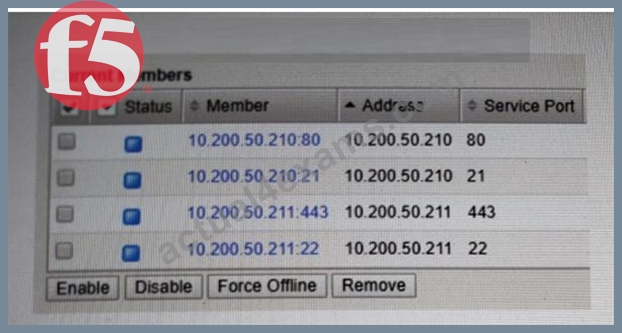
A BIG-IP Administrator needs to configure health monitors for a newly configured server pool named Pool_B.
Which health monitor settings will ensure that all pool members will be accurately marked as available or unavailable? (Choose one answer)
- A. HTTPS, HTTP, FTP, and SSH with the Availability Requirement of all health monitors
- B. HTTP, HTTPS, FTP, and ICMP with the Availability Requirement of at least one health monitor
- C. HTTPS, HTTP, FTP, and SSH with the Availability Requirement of all health monitors
- D. HTTPS, HTTP, FTP, and SSH with the Availability Requirement of at least one health monitor
Answer: D
Explanation:
From the exhibit, the pool contains different applications on different service ports (for example, HTTP/80, FTP/21, HTTPS/443, SSH/22). To mark pool members correctly, BIG-IP must be able to verify the actual service running on each member's port.
In BIG-IP Administration: Data Plane Configuration, monitor behavior is described as follows:
When multiple monitors are assigned to a pool, the Availability Requirement controls how monitor results are evaluated:
At least one = the pool member is marked up if any one of the assigned monitors succeeds.
All = the pool member is marked up only if every assigned monitor succeeds.
For pools containing members with different services/ports, using All can incorrectly mark members down because monitors intended for other services will fail on the wrong port.
Why C is correct:
Assigning HTTPS, HTTP, FTP, and SSH covers the actual services shown in the pool.
Setting the Availability Requirement to at least one ensures that each pool member is considered available when its appropriate service monitor succeeds, without being forced to pass unrelated service monitors.
Why the other options are incorrect:
A / D (Availability Requirement = all): would cause members to be marked down when unrelated monitors fail (e.g., SSH monitor against an HTTP member).
B (includes ICMP): ICMP can indicate the host is reachable even if the application service is down, which does not "accurately" reflect service availability.
Therefore, the best choice is HTTPS, HTTP, FTP, and SSH with Availability Requirement of at least one health monitor.
NEW QUESTION # 27
A BIG-IP Administrator is configuring an SSH Pool with five members. Which Health Monitor should be applied to ensure that available pool members are monitored accordingly?
- A. HTTPS
- B. UDP
- C. HTTP
- D. TCP
Answer: D
Explanation:
SSH (Secure Shell) operates over TCP port 22 , making the TCP health monitor the appropriate and correct choice for monitoring pool members in an SSH pool. The TCP monitor establishes a basic Layer 4 connection to each pool member on the designated port, verifying that the server is reachable and actively accepting TCP connections. A successful three-way handshake confirms the pool member is available; a failure marks it down and removes it from load balancing rotation.
The remaining monitor types are inappropriate for this use case:
* UDP monitor operates at Layer 4 but uses the connectionless UDP protocol, which is incompatible with SSH since SSH exclusively uses TCP as its transport.
* HTTP monitor sends a Layer 7 GET request expecting an HTTP response - irrelevant for an SSH service that does not speak the HTTP protocol.
* HTTPS monitor functions identically to HTTP but over TLS - again, completely misaligned with SSH traffic and port behaviour.
For application-specific SSH validation beyond basic TCP connectivity, an external monitor or custom monitor could be used; however, TCP remains the standard and correct built-in monitor for SSH pool verification within the BIG-IP platform.
Reference: BIG-IP Administration - Data Plane Configuration, Module: Health Monitors - Monitor Types and Protocol Alignment.
NEW QUESTION # 28
DNS queries from internal DNS servers fail when sent through a BIG-IP Virtual Server.
Which Virtual Server property should be changed?
- A. Protocol Profile (Client) to DNS_OPTIMIZED
- B. Protocol to UDP
- C. Type to Performance (HTTP)
- D. Source Address to subnet
Answer: B
Explanation:
Standard DNS queries use UDP. Configuring the Virtual Server for TCP causes DNS traffic to fail.
NEW QUESTION # 29
......
Please don’t worry about the purchase process because it’s really simple for you. The first step is to select the F5CAB3 test guide, choose your favorite version, the contents of different versionof our F5CAB3 exam questions are the same, but different in their ways of using. We have three different versions for you to choose: PDF, Soft and APP versions. The second step: fill in with your email and make sure it is correct, because we send our F5CAB3 learn tool to you through the email. Later, if there is an update, our system will automatically send you the latest F5CAB3 version.
F5CAB3 100% Exam Coverage: https://www.actual4exams.com/F5CAB3-valid-dump.html
- Free F5CAB3 Download Pdf ???? Latest F5CAB3 Exam Book ???? F5CAB3 Accurate Answers ???? ➤ www.torrentvce.com ⮘ is best website to obtain ⇛ F5CAB3 ⇚ for free download ????F5CAB3 Reliable Test Sample
- F5CAB3 Certification Exam ???? Certification F5CAB3 Exam ???? F5CAB3 Test Questions Vce ???? Immediately open ☀ www.pdfvce.com ️☀️ and search for ⮆ F5CAB3 ⮄ to obtain a free download ????F5CAB3 Valid Test Guide
- Comprehensive, up-to-date coverage of the entire F5CAB3 BIG-IP Administration Data Plane Configuration curriculum ???? Open ➡ www.dumpsmaterials.com ️⬅️ and search for ▛ F5CAB3 ▟ to download exam materials for free ????F5CAB3 Accurate Answers
- Free F5CAB3 Download Pdf ???? F5CAB3 Accurate Answers ???? F5CAB3 New Dumps Ebook ???? Download 「 F5CAB3 」 for free by simply searching on ✔ www.pdfvce.com ️✔️ ????F5CAB3 Valid Test Guide
- Quiz F5 - F5CAB3 Authoritative Reliable Braindumps Ppt ???? Immediately open ▷ www.validtorrent.com ◁ and search for ➽ F5CAB3 ???? to obtain a free download ????Latest F5CAB3 Test Dumps
- 2026 F5CAB3 – 100% Free Reliable Braindumps Ppt | Useful BIG-IP Administration Data Plane Configuration 100% Exam Coverage ???? Enter ➡ www.pdfvce.com ️⬅️ and search for 「 F5CAB3 」 to download for free ????F5CAB3 Reliable Test Sample
- Newest Reliable F5CAB3 Braindumps Ppt – 100% Pass-Sure BIG-IP Administration Data Plane Configuration 100% Exam Coverage ???? Easily obtain ⏩ F5CAB3 ⏪ for free download through ⮆ www.examcollectionpass.com ⮄ ????Latest F5CAB3 Test Dumps
- F5 Reliable F5CAB3 Braindumps Ppt: BIG-IP Administration Data Plane Configuration - Pdfvce Providers you Best 100% Exam Coverage ⚖ Search for ➥ F5CAB3 ???? on [ www.pdfvce.com ] immediately to obtain a free download ☂Certification F5CAB3 Exam
- Free F5CAB3 Download Pdf ???? F5CAB3 Reliable Test Sample ???? F5CAB3 Passing Score ???? Download ➡ F5CAB3 ️⬅️ for free by simply searching on ➤ www.pass4test.com ⮘ ????F5CAB3 Accurate Answers
- 2026 F5CAB3 – 100% Free Reliable Braindumps Ppt | Useful BIG-IP Administration Data Plane Configuration 100% Exam Coverage ???? Search for 「 F5CAB3 」 and download it for free immediately on ⏩ www.pdfvce.com ⏪ ????F5CAB3 Test Questions Vce
- 2026 F5CAB3 – 100% Free Reliable Braindumps Ppt | Useful BIG-IP Administration Data Plane Configuration 100% Exam Coverage ???? Enter “ www.testkingpass.com ” and search for ☀ F5CAB3 ️☀️ to download for free ????F5CAB3 Exam Torrent
- bookmark-master.com, myportal.utt.edu.tt, myportal.utt.edu.tt, myportal.utt.edu.tt, myportal.utt.edu.tt, myportal.utt.edu.tt, myportal.utt.edu.tt, myportal.utt.edu.tt, myportal.utt.edu.tt, myportal.utt.edu.tt, myportal.utt.edu.tt, myfirstbookmark.com, myportal.utt.edu.tt, myportal.utt.edu.tt, myportal.utt.edu.tt, myportal.utt.edu.tt, myportal.utt.edu.tt, myportal.utt.edu.tt, myportal.utt.edu.tt, myportal.utt.edu.tt, myportal.utt.edu.tt, myportal.utt.edu.tt, socialstrategie.com, lucykzco325701.wizzardsblog.com, privatebookmark.com, umarnnaq885192.vigilwiki.com, geraldhhvk863181.wizzardsblog.com, dillanumyg544550.wizzardsblog.com, Disposable vapes
BTW, DOWNLOAD part of Actual4Exams F5CAB3 dumps from Cloud Storage: https://drive.google.com/open?id=1ozxbhTa9L1xfe58tsQmJabSICZD682Px
Report this wiki page